
Tuesday, December 17, 2013
Red Thread Info Page
Come see our new Red Thread info page at http://www.owenlawncare.com/red_thread.html


Thursday, April 11, 2013
European Crane Flies
European Crane Flies
Yet another exotic insect has come along to plague us. Those large “mosquito-like” insects that
cluster on your porch in late summer especially in the evenings when the light
is on are crane flies. Don’t panic, they
don’t bite.

There are thousands of native species of crane flies that
feed on decaying vegetable matter and live near water. Only a few species have adapted to drier
environments and feed on grass roots and foliage. Two of these, Tipula paludosa (European crane
fly) and its relative T. oleracea (common crane fly) are emigrants from Europe that have made their way here through port cities
in the northeast and northwest.
Populations are firmly established on both coasts and in Ontario, and now in Michigan.
There are some significant differences in these very similar
looking pests. Oleracea has longer wings
and is a better flier while paludosa has short wings and doesn’t so much fly as
hop from spot to spot. Each female lays
about 200 eggs. Oleracea can complete
two generations per year as opposed to one for the paludosa. One might imagine that the oleracea would be
the most serious pest, but as they disperse farther, they don’t build up the
populations as quickly as do the poorer flyers.

European Crane Fly larvae feed on the roots and on damp warm
nights they will move to the surface to eat the blades of the grass plant. Damage to turf looks a lot like white grub
damage but a bit of digging will reveal a grayish larvae that has no legs as it
is a maggot instead of a grub. Healthy lawns will tolerate lesser numbers
without significant dieback. Fall
treatments are considered ideal as most of the feeding is done at that time by
the smaller and more controllable European Crane Fly larvae.

The 3rd
instar European Crane Fly larvae burrow deeper to escape the winter chill, but
may do some feeding during mild winters before rising back up in spring to
resume feeding before pupating. In June, the European Crane Fly pupae wriggles
to the surface and the adult European crane fly emerges leaving the tough pupal
casing behind either sticking up out of the ground in short mowed grass or on
the tops of blades in taller grasses.
If you see European Crane Flies or have any questions about
how to control them please visit www.owenlawncare.com
or call us at (800)-724-6680 to have one of our lawn specialists come out and
answer any of your questions or concerns. Thank you!
Wednesday, April 3, 2013
Relative toxicity Sheets
We just put together a new relative toxicity sheet for use
by our applicators. Some of it was surprising!
| Relative Toxicity | |
| Chemical Name | LD/50 |
| Abamectin | 11 mg/kg |
| Nicotine (average of 1mg per Cigarette) | 50 mg/kg |
| Caffeine | 192 mg/kg |
| Aspirin | 200 mg/kg |
| Greyhound | 300 mg/kg |
| Ammonia | 350 mg/kg |
| Alcohol (average of 17.75 mL per beer) | 400 mL/L |
| Bifenthrin I/T 7.9F | > 500 mg/kg |
| ACE-jet | 688 mg/kg. |
| Sevin SL | 699 mg/kg |
| Muriatic Acid | 900 mg/kg |
| Tempo SC | 960 mg/kg |
| Orthene | 1447 mg/kg |
| IMA-jet | >1600 mg/kg |
| Cambistat | > 2,000 mg/kg |
| Myclobutanil 20 E/W T&O | > 2,000 mg/kg |
| Safari 20 SG | > 2,000 mg/kg |
| Vintage SC | > 2,000 mg/kg |
| Imidacloprid 75 WSB | 2,591 mg/kg |
| Tylenol | 2680 mg/kg |
| Table Salt | 3,000 mg/kg |
| Propiconazole 14.3 | > 3,000 mg/Kg |
| Tree-age | 3129 mg/kg |
| Vinegar | 3310 mg/kg |
| Permethrin SFR | 3600 mg/kg |
| Shepherd | 4,340 mg/kg |
| Alamo | 4340 mg/kg |
| Conserve SC | > 5,000 mg/kg |
| Floramite SC | > 5,000 mg/kg |
| Pentathlon LF | > 5,000 mg/kg |
| Damoil | > 5,000 mg/kg |
| Arbortect 20-S | >5,000 mg/kg |
| Bleach | 5800 mg/kg |
Owen Tree Service: Plant buds signal the beginning of spring
Owen Tree Service: Plant buds signal the beginning of spring: Plant buds signal the beginning of spring In woody plants, the buds signal the end of eco-dormancy and the start of spring growth. ...
Monday, April 1, 2013
Owen Tree Service: Weevils and Zimmerman pine moths: Early spring lan...
Owen Tree Service: Weevils and Zimmerman pine moths: Early spring lan...: Weevils and Zimmerman pine moths: Early spring landscape pests to think about now Take these steps in April to prevent problems fr...
Friday, March 29, 2013

Saturday, March 23, 2013

Owen Tree Service Oakland, Macomb, Genesee, Lapeer, St. Clair County http://www.owentree.com via @OwenTreeService : Come Visit the new Site!
Thursday, March 21, 2013
Eight Steps to a Healthier Greener Lawn
Thursday, February 28, 2013
Mow high for weed and grub control
Mow at the highest setting on your lawnmower to promote deep roots, avoid grub damage and crowd out weeds.
Michigan has a tradition of mowing lawns short. Perhaps it is because many people want their lawn to look like a golf course fairway. Unfortunately, this is not practical for the average homeowner because golf course fairways are mowed three times per week with a frequently-sharpened reel mower, and irrigated daily during the summer. Trying to mow your lawn at a height less than 3 inches is actually stressful to your lawn and may result in the need to apply more insecticide and herbicide.
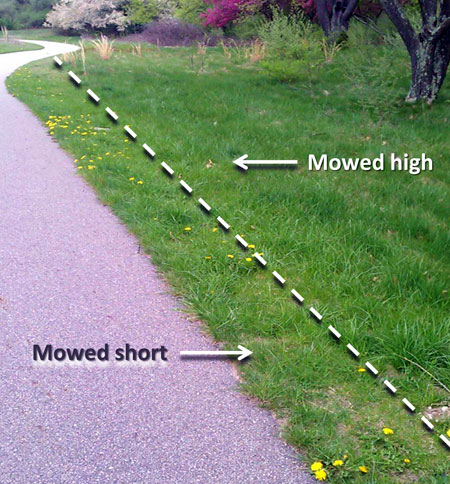
Raising the mowing height makes a more dense turf that
out-competes weeds. Photo credit: Rebecca Finneran, MSUE
What height do you mow at?
It’s easy to determine the true cutting height of your mower. Pull your mower onto your driveway or sidewalk and measure the distance from the cement surface to the bottom of the blade-protection covering that goes all the way around the path of the blades. Most lawn mowers have an adjustment that allows the mowing height to be set between 2 and 4 inches.
What mowing height is best for my lawn?
The highest setting on your mower! The top setting for most mowers gives a cutting height between 3.25 and 4 inches. This is best for your lawn, but at a setting of 4 inches you may sometimes see some “laying-over” of turf blades that some people find undesirable. For this reason, some people prefer to mow at 3 or 3.5 inches. For the healthiest and most sustainable approach, Michigan State University Extension says 3.5 to 4 inches is most desirable.

Lawns mowed at 3.5 or 4 inches out-compete weeds, tolerate
grubs and look just as good as lawns mowed at 2.5 inches.
Why is mowing high good for my lawn?
Mowing high provides five valuable services:
- It makes scalping (turf damage from mowing too short) much less likely to happen.
- It allows you to clip about 30 percent of the leaf blade each time you mow (the optimum proportion).
- It promotes establishment of a larger root system, which is more drought tolerant.
- It provides broadleaf weed and crabgrass control by shading the soil surface.
- It establishes a grub-tolerant lawn because of the larger root mass.
The weed and grub control provided by mowing high means you can use less pesticide on your lawn. In fact, if you combine mowing high with modest applications of fertilizer (1 to 4 lbs N per year, depending on how green you want your lawn), and watering during dry periods, you may not need to use any pesticides – herbicide for weeds or insecticide for grubs – on your lawn. If you have not been mowing high and watering during dry periods, you may need to do this for at least one year to establish a healthy lawn before you stop using pesticides.
Starting from the “ground up,” MSU Extension’s horticulture educators are embarking on a new campaign to help folks become “smart gardeners.” Launching this effort, MSU Extension horticulture educators will be presenting smart gardening in a variety of ways at two public shows in Michigan. The Novi Cottage and Lakefront Living Show on Feb. 21-24, and the West Michigan Home and Garden Show on Feb. 28-March 3 will host a variety of free seminars, informational booths and be the site to “ask the experts” from MSU Extension about your gardening questions.
For more information on a wide variety of smart gardening articles, or to find out about smart gardening classes and events, visit www.migarden.msu.edu.
Dr. Smitley’s work is funded in part by MSU‘s AgBioResearch.
Wednesday, February 27, 2013
Come see our new Lawn Info Center at our webpage at www.owenlawncare.com . Tell us what you think and please send more ideas of some topics to add. Thank you!
Subscribe to:
Posts
(
Atom
)